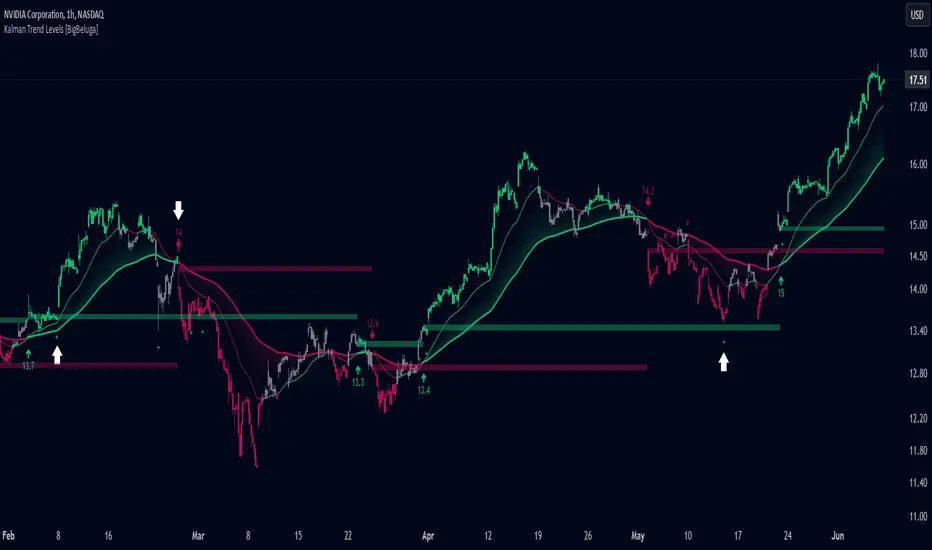


What this TradingView script does
Equilibrium Momentum Shift is a range-based momentum oscillator designed to measure how far price has deviated from its current equilibrium. Instead of focusing purely on trend direction or overbought/oversold conditions, this indicator evaluates price relative to the midpoint of its recent range and quantifies the strength of the shift away from that balance.
By combining normalized range deviation, smoothing techniques, and nonlinear compression, the indicator provides a clear view of when markets transition from equilibrium into directional momentum, now featuring Normal Divergence detection to spot potential trend reversals.
🔵 CONCEPT
- Equilibrium Midpoint — The midpoint between the highest high and lowest low over the selected range length represents the equilibrium price.
- Deviation Measurement — The indicator measures how far the current price has moved away from this midpoint.
- Range Normalization — Deviations are normalized relative to the size of the current range, allowing the oscillator to remain consistent across different volatility conditions.
- Momentum Compression — A hyperbolic tangent function compresses extreme values, stabilizing the oscillator and preventing runaway signals during large trends.
- Divergence Identification — Automatically identifies discrepancies between price action and the oscillator to highlight weakening momentum in established trends.
🔵 HOW IT WORKS 1️⃣ Equilibrium Range Calculation
- The indicator calculates the highest high and lowest low over the user-defined range length.
How traders can use it
Use Equilibrium Momentum Shift + Divegence as a chart context layer inside TradingView: read the structure it highlights, compare it with your market bias, and let the script narrow which moves deserve attention.
The strongest workflow is to combine the script with higher timeframe structure, volume context, and a repeatable execution plan instead of treating any single label as a standalone trade.